
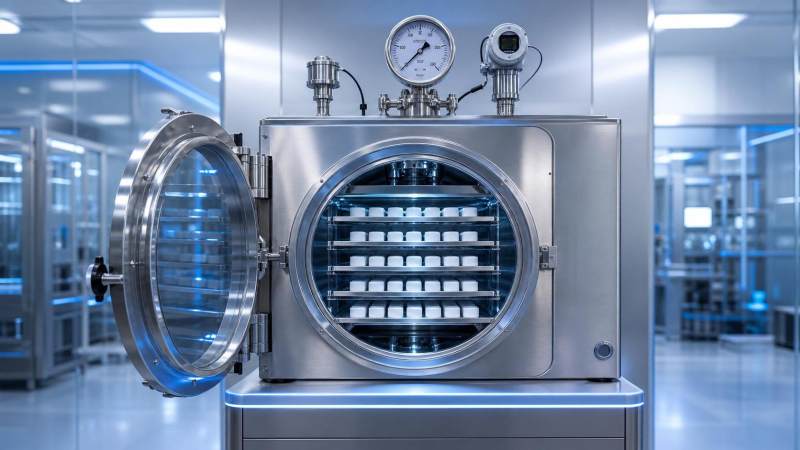
Peptide lyophilization, or freeze-drying, is a critical downstream process that converts purified peptide solutions into high-purity, stable solid powders. Far from being a simple water evaporation procedure, lyophilization is a sophisticated engineering task combining thermodynamics, fluid dynamics, and peptide biochemistry. Below are the primary technical barriers that professional peptide manufacturing facilities face during the lyophilization stage:
1. Control of Freezing Rates and Ice Crystal Morphology
During the initial freezing phase, the cooling rate directly dictates the size and shape of ice crystals. Rapid freezing produces extremely tiny crystals that impede water vapor escape during sublimation, potentially leading to structural collapse. Conversely, excessively slow freezing forms large ice crystals that can exert mechanical stress on the peptide's three-dimensional structure, causing peptide degradation or aggregation.
2. Annealing Optimization and Precise Determination of Collapse Temperature ($T_c$)
Every unique peptide sequence possesses a specific collapse temperature ($T_c$).
Annealing Protocol Optimization: For challenging peptide sequences, an annealing step is necessary to rearrange ice crystal structures and promote uniform pore distribution.
Sublimation Temperature Management: During primary drying, the shelf temperature must be strictly maintained below the peptide's $T_c$. Exceeding this threshold results in cake collapse, reduced solubility, and compromised functional purity.
3. Removal of Residual Moisture and Organic Solvents
Preparative HPLC purification of peptides frequently utilizes organic solvents such as acetonitrile (ACN) and trifluoroacetic acid (TFA). During secondary drying, manufacturers must lower residual solvent and water levels to strict regulatory limits without thermal degradation of the peptide bonds. This requires high-vacuum equipment paired with precise multi-stage temperature control.
4. Sterility Assurance and Batch-to-Batch Consistency
For pharmaceutical-grade or high-spec research peptides, lyophilization must be executed under stringent aseptic conditions (Class 100 / ISO 5). Maintaining consistent cake appearance, reconstitution speed, water content, and biological activity across large-scale batches (kilogram scale) represents a benchmark of a factory's technical capabilities.
Overcoming these technical hurdles requires not only state-of-the-art lyophilization equipment but also deep expertise in peptide chemistry and process design.