
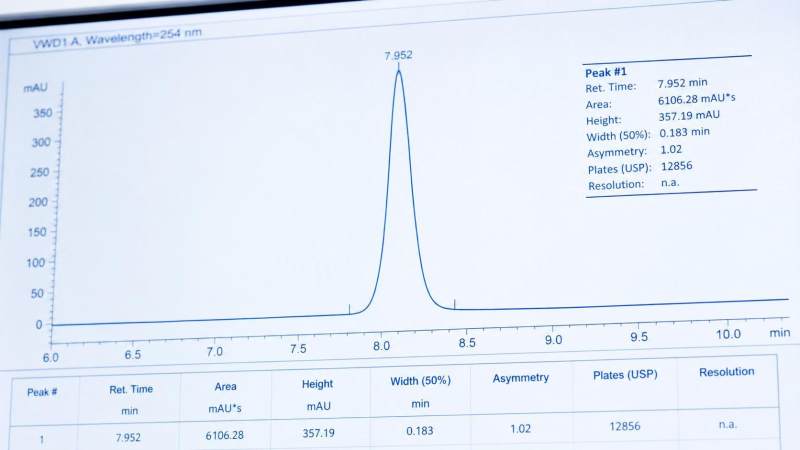
In the procurement and R&D of custom peptides, High-Performance Liquid Chromatography (HPLC) chromatograms serve as a critical standard for evaluating product quality and purity. While most peptide manufacturers provide HPLC analytical reports alongside shipment, understanding how to interpret these chromatograms independently is essential to verifying the true purity of your custom peptides.
1. Key Components of an HPLC Chromatogram
A standard HPLC report typically includes the following essential metrics:
Retention Time (RT): The time it takes for a specific analyte to pass through the chromatographic column, used for qualitative identification.
Peak Area: The area under the absorption curve, directly proportional to the concentration of the compound.
Area Percentage (Area %): The ratio of the target main peak area to the total area of all detected peaks, which directly dictates the calculated purity.
2. Three Critical Steps to Assess True Purity
Examine Peak Symmetry and Resolution: High-quality custom peptides should display a sharp, symmetrical main peak on the chromatogram. The presence of tailing, fronting, or shoulder peaks often points to closely related sequence impurities (such as deletion sequences or stereoisomers) that may distort the reported purity.
Inspect Baseline Stability and Unintegrated Peaks: Ensure the baseline remains stable throughout the run. Unintegrated minor impurity peaks or baseline drift can artificially inflate the calculated main peak percentage. A rigorous purity evaluation must account for all detectable secondary peaks.
Verify the Detection Wavelength: Peptides are typically analyzed at 214 nm or 220 nm, corresponding to the absorption wavelength of peptide bonds. Analyzing samples at inappropriate wavelengths may render certain impurities invisible, resulting in an overestimated purity value.
3. Cross-Validation with Mass Spectrometry (MS)
It is important to remember that while HPLC measures purity, it does not confirm molecular weight. The best practice for ensuring your custom peptides meet exact experimental requirements is to cross-verify the HPLC chromatogram with Mass Spectrometry (MS) data, confirming that the mass of the main peak perfectly matches the target sequence.
By mastering these chromatogram analysis techniques, researchers and buyers can make more informed decisions when choosing custom peptide synthesis partners, ensuring reliable results for downstream applications.